
About Hajee Sir Ismail Sait
A self-made industrialist, philanthropist, and visionary whose life shaped Bangalore, KGF, and communities across India.
- Home
- about us
SHORT INTRODUCTION
A Man Who Rose Above Circumstance
Hajee Sir Ismail Sait (1859–1934) was born into hardship, worked as a newspaper boy, sold goods door-to-door, and had no formal schooling.
Yet through courage, discipline, and extraordinary foresight, he became:
- a pioneering industrial magnate,
- a respected civic leader,
- a celebrated philanthropist, and
- a knight honored by King George V.
His life remains one of the most remarkable success stories in South India’s history.
Your content goes here. Edit or remove this text inline or in the module Content settings. You can also style every aspect of this content in the module Design settings and even apply custom CSS to this text in the module Advanced settings.
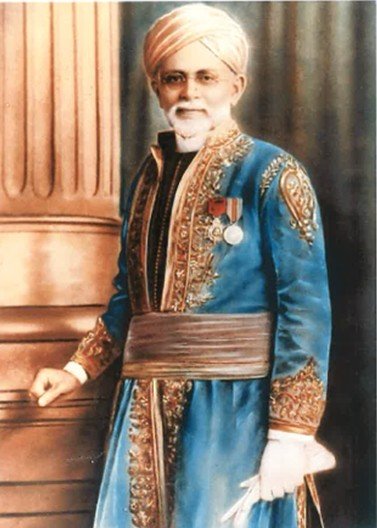
EARLY LIFE & HUMBLE ROOTS
From Mysore’s Streets to South India’s Boardrooms
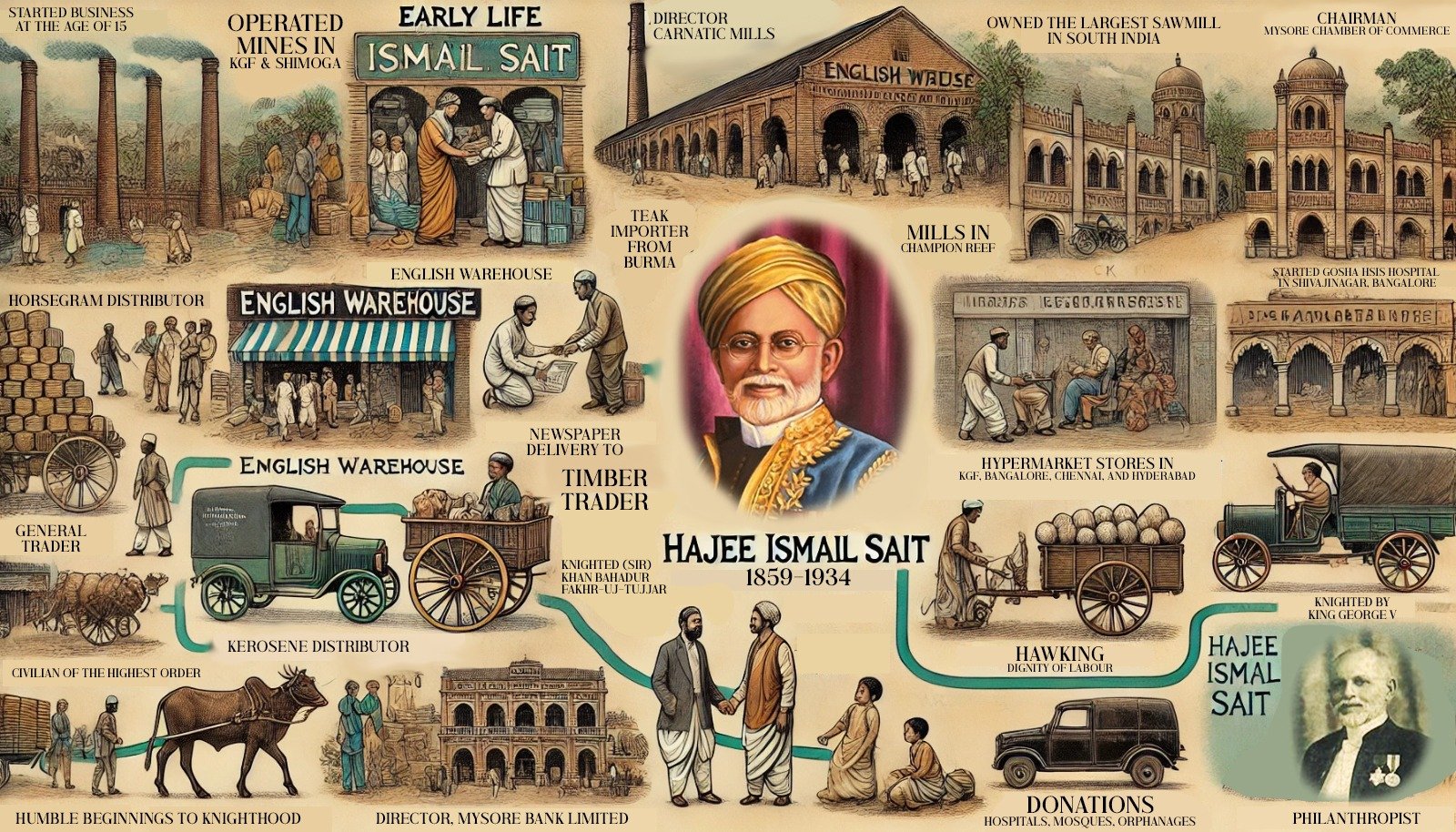
Born in Mysore, young Ismail lost his father early, forcing him to work from childhood.
He delivered newspapers, hawked goods, and ran errands — doing whatever it took to support his family.
He could not even sign his name; he used a rubber seal instead.
But he taught himself relentlessly, eventually mastering:
- 13 Indian languages, and
- English, French, German, Spanish, Latin, and Arabic.
His early struggles planted the seeds of empathy that later shaped his philanthropy.
KGF The Turning Point
In his teens, he moved to the Kolar Gold Fields, where he saw firsthand the needs of miners, British officers, and local families.
He began as a supplier of horse gram to the British cavalry.
But soon, he sensed a gap: KGF lacked a proper general store.
At just 20 years old, in 1879, he founded:
The English Warehouse
A revolutionary store offering imported goods — from textiles to canned food — becoming South India’s earliest hypermarket.
KGF became the launchpad of his industrial empire.
RISE AS AN INDUSTRIAL LEADER
A Visionary Builder of Business & Infrastructure
Detailing his expanding enterprises including timber operations, mining in KGF & Shimoga, railway sleeper supply, import/export networks, textile, sugar, and oil factories, kerosene distribution, and banking institutions
Mining & Timber
Vast operations in KGF & Shimoga, supplying critical resources
Mining & Timber
Vast operations in KGF & Shimoga, supplying critical resources
Mining & Timber
Vast operations in KGF & Shimoga, supplying critical resources
Mining & Timber
Vast operations in KGF & Shimoga, supplying critical resources
HONORS & RECOGNITION
A Life Recognized by Kings & States
Knighthood (Sir) — King George V (1925)
Fakhr-ut-Tujjar (Pride of Merchants) — Maharaja of Mysore
OBE, KCSI, GCIE, Kaiser-i-Hind
Magistrate of Bangalore
Khan Bahadur — Mysore State
Knighthood (Sir) — King George V (1925)
Nominated Member — Madras Legislative Council (1911)
Chairman — Mysore Chamber of Commerce (FKCCI)
These honors reflected not wealth, but service.
HIS LEGACY TODAY
Why His Story Still Matters
Despite his success, he lived simply, treated all with dignity, and believed deeply in giving without seeking recognition.
His values:
Fair dealing
Empathy for the poor
Discipline in business
Integrity in public service
Strong family and community bonds
He never forgot his beginnings — and that shaped every act of generosity.