
A Legacy of Giving: The Philanthropy of Hajee Sir Ismail Sait
From hospitals and schools to mosques, orphanages, and global rellef, HSIS devoted his fortune to building institutions that would outlive him and uplift generations
A Philanthropist Second to None
In an age before corporate foundations and large NGOs, Hajee Sir Ismail Sait quietly built a personal tradition of giving that reshaped life in Bengaluru and far beyond. His wealth flowed into hospitals, schools, mosques, orphanages, and civic institutions that served people across faiths and social backgrounds. For HSIS, philanthropy was never a matter of public display. It was a moral obligation, guided by faith, a deep sense of justice, and a clear-eyed understanding of what communities needed most: healthcare, education, dignity, and steady sources of livelihood. The institutions he founded and funded were designed not for short-term relief, but for continuity. Many still stand today – living testaments to his belief that true charity creates lasting structures of care
Dignity for the Vulnerable
Ensuring that women, orphans, the sick, and the poor received care without compromising their dignity or beliefs
Institutions, Not Incidents
Building schools, hospitals, and mosques that could endure and serve long after individual donations were forgotten
Faith in Action
Treating wealth as a trust from God, to be used wisely in service of community and common good
Inclusiveness Across Borders
Responding to appeals from across India and the wider world, from local relief to international humanitarian funds
HSIS Government Urdu & English Higher Primary School
A school founded through HSIS’s commitment to accessible education in Frazer Town.
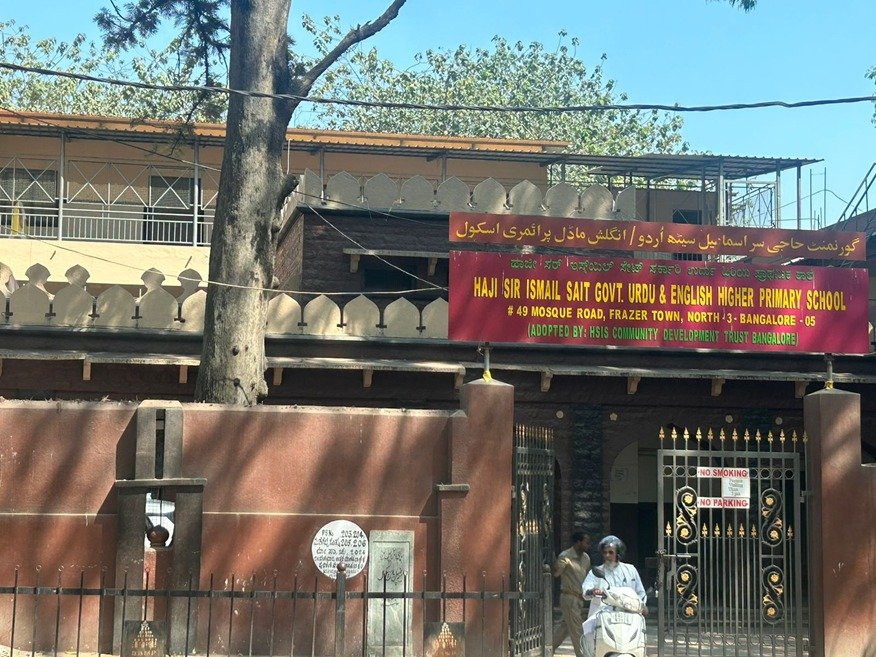
Located on Mosque Road, Frazer Town, the HSIS Government Urdu & English Higher Primary School stands as an enduring symbol of Hajee Sir Ismail Sait’s dedication to education.
Originally supported through his philanthropy, the institution continues to serve children from diverse backgrounds.
Today, it operates with support from the HSIS Community Development Trust, carrying forward his legacy of promoting learning and upliftment for underserved communities.
Healthcare: Healing Communities With Dignity
HSIS saw healthcare as a right, not a privilege. His giving focused on institutions that could treat thousands with respect and care
Flagship Institution
Gosha Hospital, Shivajinagar (1925)
Endowed by HSIS Established for purdah-observing women
Built at a time when many women could not access mainstream medical facilities, Gosha Hospital was designed to offer safe, culturally sensitive, and high-quality care.
“If our women cannot safely reach the hospital, then the hospital must reach them in the form they can accept.”
Attributed to HSIS in contemporary accounts
Legacy Today The institution remains a landmark of women’s healthcare in Shivajinagar, remembered as one of HSIS’s most visionary gifts
Major Hospitals & Wards Funded
- Beyond Gosha Hospital, HSIS supported key medical facilities across the city.
- Donations to major general hospitals in Bengaluru for new wards and critical equipment.
- Support for specialized wards serving tuberculosis patients and the urban poor.
Contributions to maternity and child-care units serving women across communities. - Regular gifts towards medicines, bedding, and upkeep of charitable medical institutions.
TB Relief Efforts
Tuberculosis was one of the most feared diseases of his time. HSIS responded with sustained support for TB wards, sanatoria, and relief funds, helping patients who were often turned away elsewhere.
From early relief funds to dedicated wards, his TB philanthropy followed the spread of the disease and adapted to new needs
Education: Empowering Through Knowledge
Schools & Colleges Supported
- Endowments to local schools in Bengaluru serving children from trading, artisan, and working families.
- Support to religious and secular institutions that combined moral instruction with modern subjects.
- Scholarships for promising students who lacked the means to continue their studies.
- Grants for libraries, reading rooms, and the purchase of books to expand access to knowledge
His Philosophy
HSIS believed that learning should equip a person to serve society and stand with integrity in the world. His giving cut across faith and class, insisting that ability and character, not birth, should determine opportunity.
“Philanthropy must not become business.”
For him, educational philanthropy was not a way to gain influence or returns, but a trust to enable the next generation.
Faith, Community, and Inclusiveness
His religious giving sought to strengthen faith while serving everyday needs of the community
1 Mosques as Community Anchors
HSIS funded the construction and upkeep of mosques that served not only as places of prayer but as gathering spaces, dispute-resolution forums, and centers of learning.
2 Orphanages and Shelters
He supported orphanages that provided food, shelter, and education, seeking to give every child a sense of belonging and a chance at a stable future.
3 Religious Schools and Endowments
Madrasas and religious schools received funds to pay teachers, maintain buildings, and support poor students in their studies.
4 Inter-Community Support
While rooted in his own faith, HSIS contributed to causes that crossed communal lines, reflecting a broader vision of shared civic life.
5 Endowments for Continuous Income
Instead of one-time alms, he often created endowments tied to properties or businesses whose income would permanently sustain religious and charitable institutions.
This was philanthropy designed to generate continuous income, not one-time charity.
HSIS’s model ensured that mosques, orphanages, and religious schools could plan for the future with steady, predictable support
Strengthening Public Life & Infrastructure
HSIS understood that flourishing cities require more than private generosity; they need shared
spaces, public amenities, and robust civic institutions. His giving extended into the very fabric of
Bengaluru’s public life
- Funding for public drinking water fountains and wells in areas with limited access to clean water.
- Support for road and neighborhood improvements that made trade and daily life easier for ordinary residents.
- Contributions to public halls and community spaces used for meetings, education, and social gatherings.
- Assistance to municipal and civic bodies in times of strain, helping them continue essential services
Famine Relief: Standing With the Hungry
When famine and scarcity struck. HSIS stepped in with large-scale food relief, grain distribution, and financial assistance. Contemporary records and panels recall now he personally oversaw arrangements to ensure that aid reached the most vulnerable.
“In times of hunger, charity cannot wait for ceremony.”